
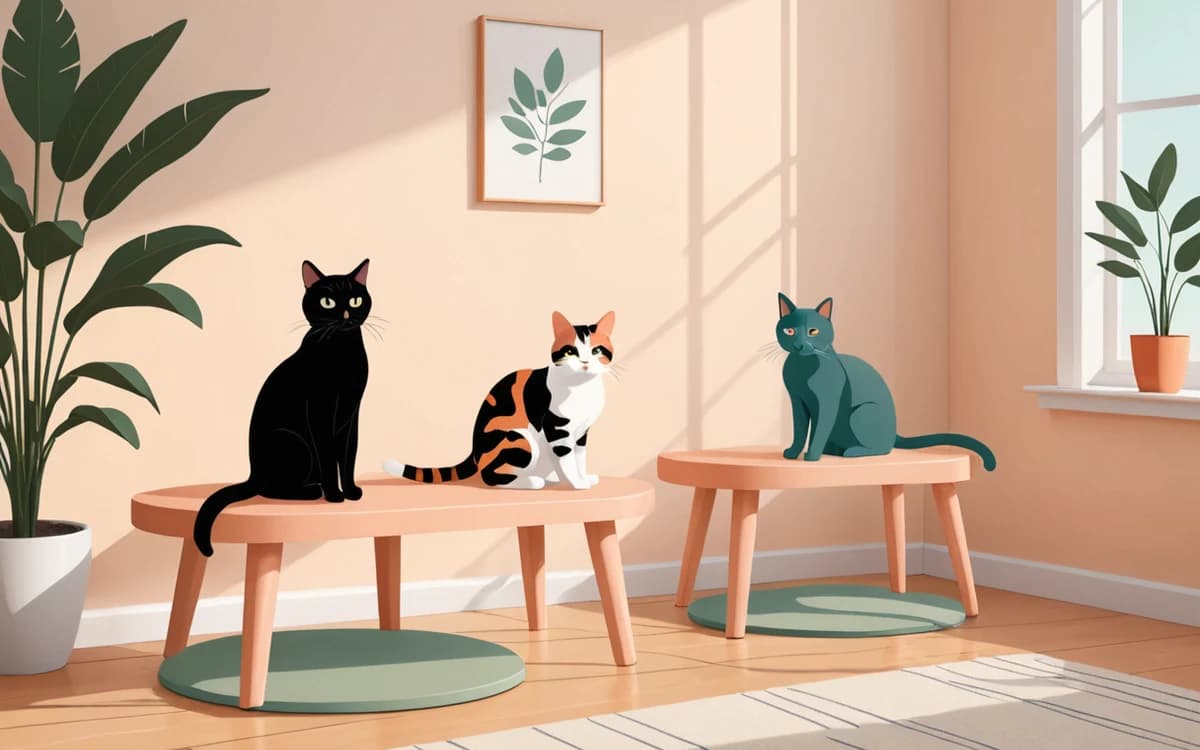
Peace in a multi-cat home mostly comes down to resources and space: give each cat their own litter box, bowl, water point, and resting spot (the N+1 rule), spread those resources across different rooms so no cat can block access to all of them at once, and watch each cat individually — chronic stress usually shows up in one cat first, not the whole household equally.
Quick checklist:
- Apply the N+1 rule: one litter box, bowl, and resting spot per cat, plus one extra
- Spread resources across separate rooms rather than clustering them in one spot
- Watch for a cat avoiding a room, blocking a doorway, or over-grooming
- Track each cat's behavior individually — stress rarely hits every cat the same way
- Separate cats temporarily after open conflict, then reintroduce slowly
Why multi-cat households get tense
Cats are territorial by nature and, unlike dogs, they don't form a single cooperative group by default. Two cats can share a home for years without ever becoming friends, and that's not automatically a problem — many cats coexist as "time-share" roommates who simply avoid each other on a schedule. Real tension shows up when that avoidance stops being possible: when resources, routes through the house, or your attention become things one cat has to compete for.
Most conflict in a multi-cat home is quiet. Outright fighting is actually rare compared to the passive tension of staring, blocking, and resource guarding, which can run for months without an owner noticing anything beyond "they don't really get along." If the two cats were introduced too quickly or without a structured process, that friction often traces back to the introduction itself — our guide to introducing cats to each other covers how to redo that process properly, even for cats who already live together.
The N+1 rule: enough resources for every cat
The N+1 rule is the standard starting point recommended by feline behaviorists: for every resource that matters to a cat, provide one per cat in the household, plus one extra. Two cats means three litter boxes. Three cats means four feeding stations. The "plus one" matters because it removes the scenario where a single resource is the only option and one cat can control it just by sitting nearby.
This isn't about generosity — it's about removing the need to compete. A cat doesn't have to hiss or swat to keep another cat away from a litter box; simply occupying the room, or the doorway leading to it, is often enough. When there's only one option, that quiet blocking works. When there are three spread around the home, it stops being worth the effort.
| Resource | N+1 rule | Why it matters |
|---|---|---|
| Litter boxes | Cats + 1, in separate rooms | A confident cat can guard a single shared box without ever needing to fight |
| Food & water bowls | One set per cat, spaced apart | Eating near a cat they're tense with is stressful for many cats, even without direct conflict |
| Resting or sleeping spots | At least one per cat, ideally elevated | Guarantees each cat a retreat that isn't already claimed |
| Scratching posts | One per cat, in different rooms | Reduces competition over the one high-value spot |
| Vertical space (perches, shelves) | Several, at different heights | Lets a lower-confidence cat observe the room without walking through it |
Our guide to building a stress-free home for your cat goes through room-by-room placement for these resources in more detail, which matters as much as the count.
Spread resources out — the layout matters as much as the count
Meeting the N+1 count on paper doesn't help much if all three litter boxes sit side by side in the same laundry room, or all the food bowls are lined up on one counter. That's still a single location a confident cat can control. Resources need to be genuinely distributed: different rooms, different floors if you have them, and reachable by more than one route.
Pay particular attention to choke points — narrow hallways, the top of a staircase, a doorway between two rooms. These become natural ambush spots where one cat can control access to an entire part of the house just by lying there. Where possible, arrange furniture so cats have at least two ways to reach a litter box or food bowl, and avoid placing a resource at the dead end of a hallway with no second exit.
Signs of chronic tension between cats
Open fighting is the obvious sign, but most multi-cat stress shows up as smaller, easy-to-miss patterns:
- One cat consistently avoids a room or floor they used to use freely
- A cat blocks a doorway, hallway, or the top of the stairs, forcing the other to detour or wait
- Long staring matches, or one cat freezing and backing away before entering a room
- A specific cat over-grooming in one area (often the belly or flank), which is a common stress response rather than a grooming preference — our guide to reading cat body language covers what to look for
- A previously social cat withdrawing from mealtimes, play, or your lap specifically when the other cat is nearby
None of these need to happen every day to matter. A pattern that repeats over a week or two is more telling than any single incident.
Working out which cat is actually struggling
This is the step people skip, and it's the one that actually matters: there's no single fix that works for "the household." One cat is almost always more affected than the other, and it's frequently the quieter, less assertive cat — the one who looks "fine" because they've simply stopped contesting resources, not because there's no tension. Assuming the calmer-looking cat is unaffected is one of the most common mistakes in multi-cat homes.
Working this out takes individual observation, not a household-wide guess. Track each cat separately: appetite, litter box use, time spent hiding, grooming habits, and where they choose to rest. Our guide to tracking cat stress and behavior covers a simple system for logging this consistently enough to spot a pattern rather than reacting to a single bad day.
Calm Cat lets you keep a separate profile for each cat in your home, which makes it easier to spot which one is actually struggling instead of treating the household as a single unit — free to download on iOS and Android, in five languages.
Try calming music with Calm Cat
Free download — iOS & Android, 5 languages.


When to separate cats temporarily
If there's an open fight — real contact, not just noise — separate the cats immediately into different rooms with their own resources, and treat any wounds or check for injury before anything else. Don't rush a reintroduction just because things seem calm again an hour later; adrenaline and stress hormones stay elevated for longer than that.
Once both cats are physically fine, reintroduce them the way you would two cats meeting for the first time: separate spaces, scent swapping, feeding on either side of a closed door, and short supervised sessions before returning to free access. Our guide to introducing cats to each other walks through that process step by step — it works just as well for cats resetting a damaged relationship as it does for new introductions.
Keeping the peace long-term
Multi-cat households aren't a problem you solve once. A new cat, a house move, a piece of furniture blocking a usual route, or even a change in your own schedule can shift the balance again. Revisit the resource count and layout whenever something in the home changes, and keep an eye on the individual patterns above rather than assuming that "no fighting" means "no tension." Quiet coexistence, where cats calmly share space without needing to avoid each other, is the actual goal — not just the absence of visible conflict.
Frequently asked questions
Is it normal for cats in the same home to never really bond? Yes. Many cats coexist perfectly well without becoming close companions — they simply timeshare the space and avoid overlapping. That's a normal outcome, not a failure, as long as neither cat is showing signs of chronic stress.
How long should I keep cats separated after a real fight? There's no fixed number — it depends on how the reintroduction goes. Most owners need at least a few days of full separation before starting the scent-swapping and gradual reintroduction steps, and some cats need several weeks of slow, supervised sessions before returning to full access.
One of my cats seems to be losing the standoff — should I consider rehoming? This is a decision worth making with a vet or a certified feline behaviorist rather than on your own, especially if you've already tried the resource and layout changes above without improvement. They can assess whether the tension is manageable or whether the stressed cat's welfare genuinely requires a different living situation.