
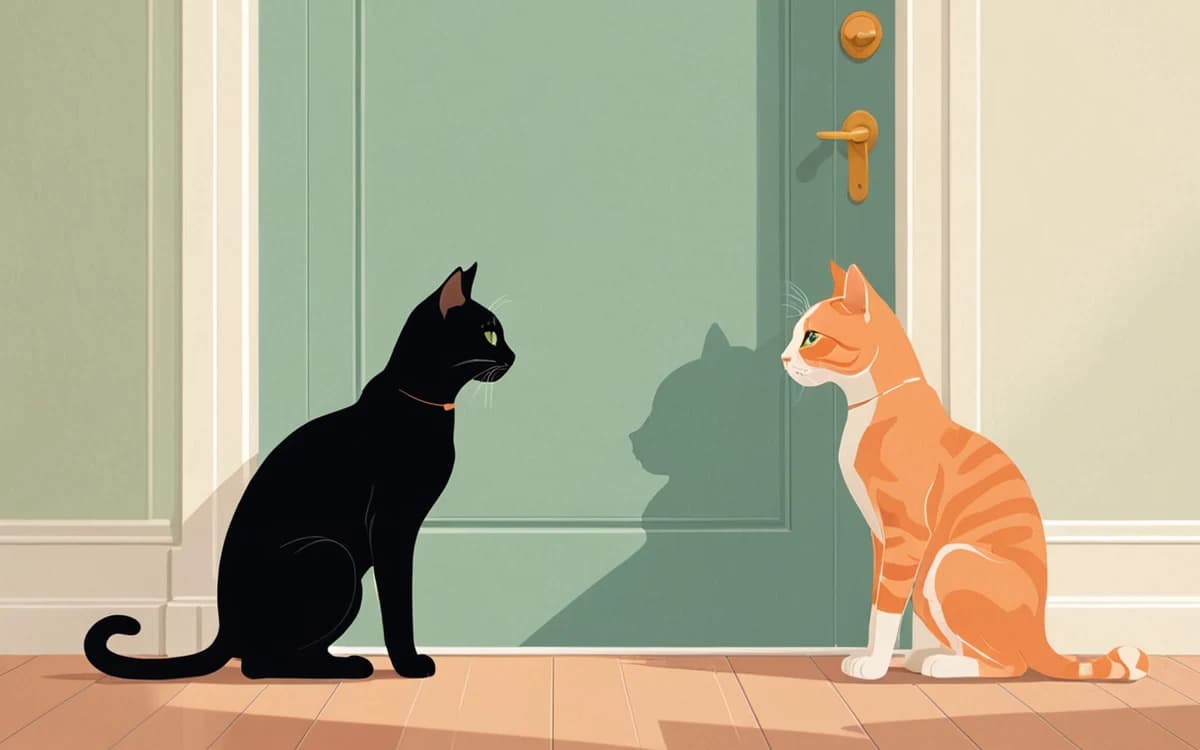
Introducing two cats works best as a slow, four-step process: separate them completely and swap scents first, then swap spaces without visual contact, then allow brief supervised sightings through a cracked door or barrier, and only then short shared time with positive distractions. Most pairs need two to eight weeks; rushing is the most common cause of failure.
Quick checklist:
- Keep the cats fully separated for the first few days, swapping bedding or towels to exchange scent
- Move on to swapping rooms so each cat explores the other's space without meeting
- Introduce short, controlled visual contact through a cracked door or barrier before any face-to-face meeting
- Watch for calm curiosity or mutual indifference as the sign to progress, not just the absence of hissing
- Slow down or go back a step at any sign of sustained growling, flattened ears, or a cat that won't come out at all
Why rushing backfires
Cats are territorial and don't form social bonds the way dogs do — a new cat is a stranger arriving in someone else's home, not an instant friend. Two cats forced together too fast can build a lasting negative association with each other that's far harder to undo than the extra two or three weeks a proper introduction takes. The method below works with a cat's senses in the order they actually use them: smell and territory first, sight second, shared space last. Reversing that order is the single biggest reason introductions fail.
Step 1: Total separation and scent swapping
For the first several days, keep the new cat in a separate room with its own litter box, food, water, and bed, and don't let the cats see each other at all. Swap a blanket, towel, or bed between the two spaces every day or two so each cat gets used to the other's scent without any pressure attached to it. Some owners also gently rub a cloth on each cat's cheeks and set it down near — not directly under — the other cat's food bowl, so the unfamiliar smell starts to associate with something good. This step usually takes 3 to 7 days, longer if either cat seems unsettled by the scent alone.
If the new cat has only just arrived in your home, it's also adjusting to a brand-new space at the same time. Our guide to helping a new cat adjust covers that parallel process week by week.
Step 2: Swapping spaces without eye contact
Once both cats are eating and behaving normally near the scent-swapped items, let them take turns exploring each other's space while the other is shut away or out of the room. This lets each cat pick up the other's scent throughout an entire territory, not just on one item, and start associating that broader smell with something familiar rather than threatening. A few sessions spread over 3 to 5 days is usually enough before moving on to visual contact.
Step 3: Controlled visual contact
This is where many introductions go wrong by skipping straight to a full meeting. Instead, create a barrier — a door propped open a few inches, a baby gate, or a screen door — so the cats can see and sniff each other without full access. Keep sessions short, five to ten minutes, and end on a calm note rather than waiting for a problem to appear. Feeding both cats on either side of the barrier at the same time, or using treats and toys during the session, helps build a positive association with each other's presence. Watch their posture closely during these sessions — our guide to reading cat body language breaks down what relaxed ears, tail, and eyes look like versus tense ones. Repeat daily for a week or more before removing the barrier.
Step 4: Supervised time together
Once visual contact through the barrier has stayed calm for several sessions in a row, allow short periods of full access to the same room under close supervision. Keep the first sessions to a few minutes, with a game or a few treats scattered on the floor to give both cats something to focus on besides each other. Always end the session before either cat shows signs of tension, and separate them again between sessions rather than jumping straight to living together full-time.
The four steps at a glance
| Step | Typical duration | Signal to move on |
|---|---|---|
| 1. Total separation + scent swap | 3–7 days | Both cats eat and rest normally near the swapped scent item |
| 2. Space swap, no visual contact | 3–5 days | No hissing or avoidance when entering the other's space |
| 3. Controlled visual contact | 1–2 weeks | Calm curiosity or mutual ignoring through the barrier |
| 4. Supervised time together | 1–3+ weeks | Short sessions stay calm, with no growling, hiding, or chasing |
Warning signs it's time to slow down
- Sustained growling, hissing, or yowling that doesn't fade within a minute or two
- Flattened ears, a puffed-up tail, or a crouched, ready-to-flee posture held for the whole session
- One cat refusing to eat, use the litter box, or come out of hiding for more than a day after a session
If you see any of these, go back to the previous step for several more days before trying again. There's no fixed timeline that works for every pair — some cats are ready to meet within two weeks, others need two months, and both outcomes are normal.
Signs you're ready to move forward
- Calm curiosity: sniffing toward the barrier or door without tension in the body
- Mutual, relaxed indifference — both cats going about their business a few feet apart
- Eating, playing, or grooming normally while the other cat is nearby or visible
Try calming music with Calm Cat
Free download — iOS & Android, 5 languages.


During an introduction, it's often the quieter cat — not the one hissing — who is more stressed. Logging each cat's behavior separately in Calm Cat's per-cat tracking can help you spot which one is actually struggling even when the signs are subtle, so you know which side of the introduction needs to slow down. See our guide to tracking cat behavior for a simple system to log this even without an app.
If things aren't going well
A stalled introduction is common and doesn't mean it will fail — it usually just means one step needs more time. Go back one stage, extend it by another week, and resist the urge to force a meeting out of impatience. If the cats have already met and there's ongoing tension weeks or months later, that's a slightly different problem: see our guide to keeping the peace in a multi-cat household for the resource setup — separate food, water, litter, and resting spots — that reduces friction long after the introduction is technically over. Every cat also needs its own safe base to retreat to, even once they're getting along; our guide to building a stress-free home covers how to set that up room by room.
Frequently asked questions
How long does introducing two cats usually take? Anywhere from two weeks to two or three months, depending on the cats' personalities, past experiences, and how much time you can dedicate to short daily sessions. Kittens and easygoing adults often move through the steps faster than adult cats with a strong territorial streak.
Can I skip straight to letting them meet if they seem calm through a window or gate? It's tempting, but skipping the scent-swapping and space-swapping steps removes the groundwork that makes the visual-contact stage go smoothly. A few extra days at each early step is a small cost compared to restarting after a bad first meeting.
What if the cats never stop fighting or avoiding each other? Some pairs take longer than others, and a small amount of hierarchy-testing is normal. But if sustained aggression, injury, or one cat hiding almost permanently continues for more than a few weeks despite slowing the process down, talk to your vet or a certified feline behaviorist — persistent conflict can also point to an underlying stress or health issue worth ruling out.