
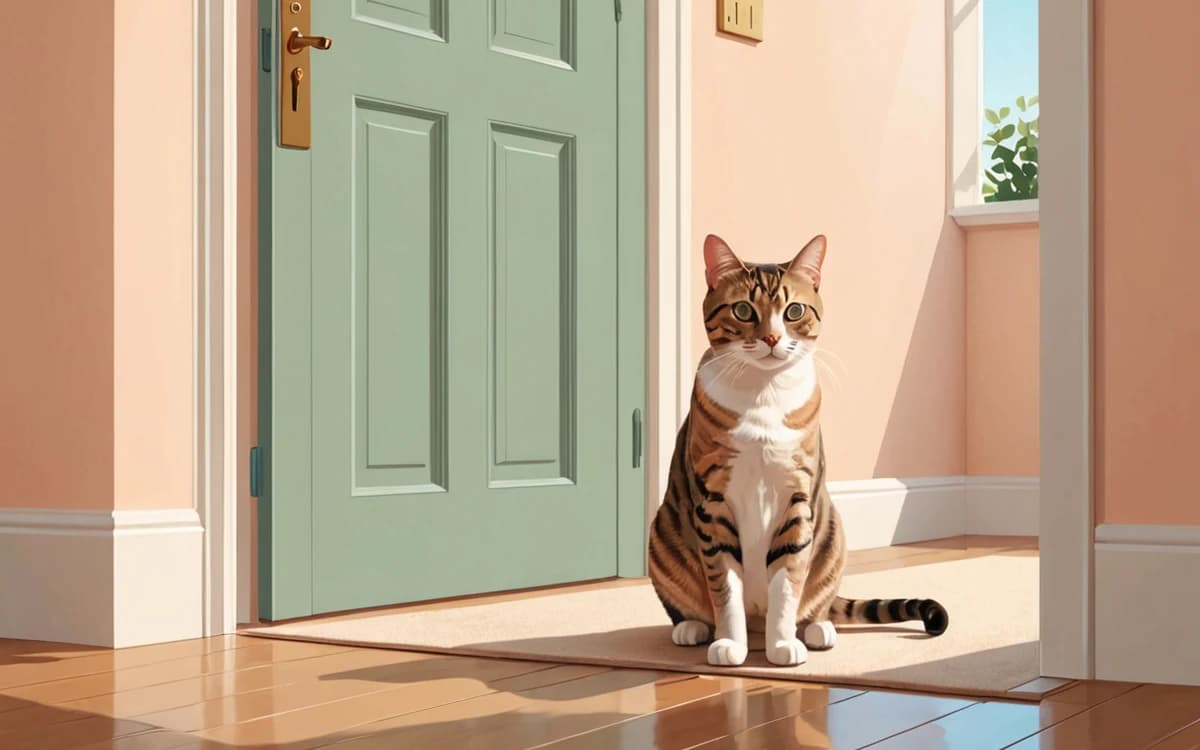
Cat separation anxiety shows up as excessive meowing, destruction, or accidents outside the litter box — but only when you're gone, not when you're home. It's driven by a strong attachment to you and a lack of coping tools for being alone, and it usually improves with low-key departures, enrichment, and a stable routine rather than punishment.
Quick checklist:
- Look for behaviors that happen only in your absence, not all the time
- Rule out boredom and medical issues before assuming it's separation anxiety
- Keep arrivals and departures low-key, without a big ceremony
- Add food puzzle toys and enrichment to occupy the alone time
- Build a stable routine so your absence becomes predictable, not alarming
What separation anxiety actually looks like in cats
Cats are often described as independent, but many form a strong bond with one person or with the household as a unit, and some genuinely struggle when that person leaves. Separation anxiety isn't a tantrum — it's a stress response. The key marker is timing: the behavior appears specifically around your departure or during your absence, and often stops as soon as you're back, sometimes with an exaggerated, almost frantic greeting.
This is different from a cat who's simply bored. A bored cat might scratch furniture or knock things over occasionally regardless of whether you're home. A cat with separation anxiety typically has a much tighter pattern tied to your comings and goings — accidents that only happen when you're out, or vocalizing that starts within minutes of the door closing.
The signs to watch for
- Excessive vocalizing when you're gone. Meowing, yowling, or crying that neighbors or a camera picks up while you're out, but that doesn't happen (or barely happens) when you're home.
- Destructive behavior tied to your absence. Scratched doors, chewed cords, or knocked-over items concentrated around exits or your usual sitting spots.
- House soiling only when alone. Using the litter box normally when you're around, but having accidents near the door or on your bed specifically while you're out.
- Over-grooming during or after your absence. Bald patches or raw skin, especially on the belly or legs, that seem to track with time spent alone.
- Following you obsessively before you leave. Pacing, blocking the door, or vocalizing as soon as you pick up your keys or put on shoes.
Not every cat shows all five. One or two consistent, absence-linked patterns are usually enough to suspect separation anxiety rather than something else.
What causes it
A strong one-on-one attachment. Cats that bonded closely with a single person, especially through a stressful period (a move, another pet's illness, your own life change), can become more dependent on that person's presence as a stability anchor.
A sudden change in routine. A schedule that shifts abruptly — a new job with longer hours, a return to the office after working from home, a change in who's usually around — can trigger anxiety even in a cat that was previously fine being alone.
Early hand-rearing or bottle-feeding. Kittens who were bottle-fed or separated from their mother and littermates very early sometimes miss out on learning to self-soothe, and can carry a higher baseline need for closeness into adulthood.
If you're not sure whether what you're seeing is separation anxiety, boredom, or something else, a few weeks of simple tracking makes the pattern obvious — note what happens and when relative to your comings and goings. Calm Cat's stress tracking is built for exactly this, and its calming sound library can run quietly in the background while you're out, which some anxious cats find genuinely settling.
Separation anxiety vs. simple boredom
| Separation anxiety | Simple boredom | |
|---|---|---|
| When it happens | Specifically tied to your absence | Any time, home or not |
| Vocalizing | Starts near departure, may continue throughout | Occasional, not tied to your leaving |
| Litter box accidents | Only while you're out | Rare, usually unrelated to timing |
| Greeting on return | Often intense or frantic | Normal, low-key |
| Fixes best with | Departure routine, enrichment, gradual absence training | More play, more environmental variety |
How to help a cat with separation anxiety
- Make departures and arrivals low-key. Skip the long goodbye and the excited hello — both teach your cat that these moments are a big deal worth getting worked up about. A calm "see you later" and an equally calm return, ignored for the first minute or two, helps flatten the emotional spike.
- Use food puzzle toys to occupy the alone time. A slow feeder or treat-dispensing toy set out just before you leave gives your cat something absorbing to do in the first stretch of your absence, when anxiety is often highest.
- Add environmental enrichment. Window perches, vertical space, and rotating toys give a cat more to engage with on their own. Our guide to indoor cat enrichment covers budget-friendly setups that make alone time less empty.
- Keep the daily routine stable. Consistent feeding times, play sessions, and even the order of your morning routine give a cat something predictable to anchor to, which makes your absence feel like part of a pattern rather than a disruption.
- Play calming background sound while you're out. Soft, consistent sound can mask sudden outside noises and give an anxious cat something steady to settle against. It works best as one part of a routine, not a fix on its own.
- Consider a pet camera to observe, not to hover. A camera lets you actually see what happens — whether the vocalizing is constant or brief, whether it's tied to a specific noise — so you can adjust your approach based on real information instead of guesswork.
Try calming music with Calm Cat
Free download — iOS & Android, 5 languages.


Tracking whether it's actually working
Because separation anxiety plays out while you're not there to see it, it's easy to guess wrong about what's helping. A short log — even a few notes after each outing about what you heard or saw on camera — turns vague impressions into a pattern you can act on. Our guide to tracking cat stress and behavior walks through a simple system that works whether or not you're using an app.
When to talk to a vet
Separation anxiety is a behavioral pattern, but some of its signs — soiling outside the litter box, over-grooming, appetite changes — can also point to a medical issue, and the two aren't always easy to tell apart at home. If accidents or over-grooming are new, worsening, or paired with any physical symptom, it's worth ruling out a medical cause before treating it purely as anxiety. See our guide on why cats hide if withdrawal is also part of the picture, and our guide on calming a stressed cat for the broader routine and environment basics that support any anxious cat, not just around departures.
Frequently asked questions
How long does it take to see improvement? Consistent, low-key departures and added enrichment often show some improvement within a couple of weeks. More established patterns, especially in cats with a history of hand-rearing or a recent major routine change, can take longer. If there's no change at all after a month of consistent effort, that's a reasonable point to loop in a vet or a feline behaviorist.
Is it okay to leave calming music playing the whole time I'm out? For most cats, yes, if it's genuinely calming and not just background noise — the goal is a steady, familiar presence rather than silence broken by unpredictable sounds. If you're gone for very long stretches, pairing it with a puzzle toy or two keeps the first hour, when anxiety tends to peak, more occupied.
Should I get a second cat so mine isn't alone? Sometimes it helps, but it isn't a reliable fix and can backfire if your cat isn't naturally sociable — a poorly matched second cat can add stress on top of what's already there. This is worth discussing with a vet or behaviorist who knows your specific cat rather than deciding based on the anxiety alone.