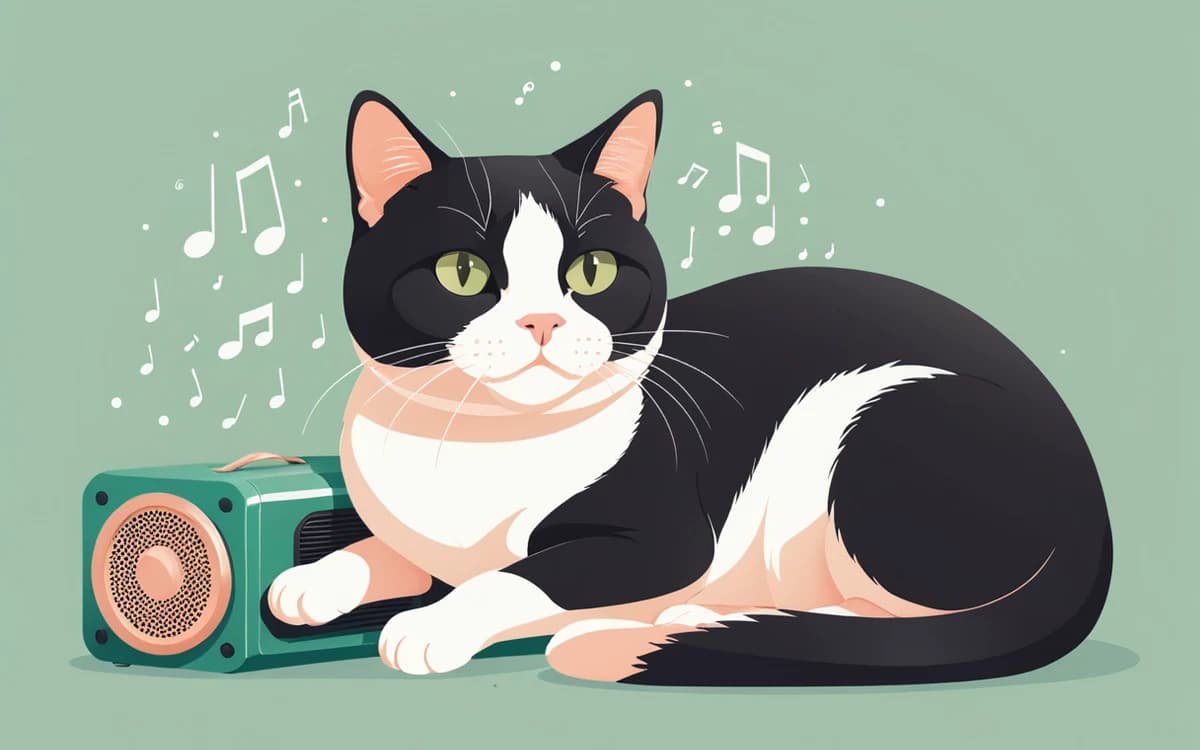
Calming music for cats is a real, research-backed tool — but it only helps when the sound matches what cats actually respond to, and when you use it at the right moments rather than as constant background noise. Low frequencies, a steady tempo, and no sudden peaks matter far more than which genre you pick.
Quick checklist:
- Look for low frequencies (roughly 25–150 Hz) and a steady, purr-like rhythm
- Play it before and during the specific stressful window, not all day
- Keep the volume low — barely audible is usually enough
- Avoid sudden peaks, key changes, or unfamiliar instruments
- Give a new track two or three tries before deciding it isn't working
Does calming music for cats actually work?
The short answer is: some music helps, and most human music doesn't do much either way. Cats hear a much wider frequency range than we do and communicate largely through pitch, tempo, and texture rather than melody, so the average pop or classical track — built for human ears and human emotional cues — often registers as neutral background noise rather than anything calming.
What does appear to matter is sound built around frequencies and rhythms closer to what cats naturally produce and respond to, like purring and nursing sounds. Researchers including Charles Snowdon and composer David Teie explored this idea directly, building "cat-specific" music around feline vocal ranges and tempos rather than adapting human compositions. The general finding across that line of research is that cats show more interest in and calmer responses to species-appropriate sound than to standard human music — though, as with most animal behavior research, results vary by individual cat and shouldn't be treated as a guaranteed fix.
Which frequencies and sounds actually calm a cat?
A cat's purr typically sits in a low-frequency range, and that range is well documented as one many owners and researchers associate with relaxation and self-soothing behavior in cats. You don't need to know the exact number to use this — the practical takeaway is simpler: cats generally respond better to low, steady, rumbling sound than to bright, high-pitched, or rhythmically unpredictable audio. For more on the purr itself, see our guide to the science behind a cat's purring frequency.
| Sound feature | Tends to help | Tends to stress |
|---|---|---|
| Frequency range | Low, closer to a purr | High-pitched or shrill |
| Tempo | Steady and predictable | Sudden tempo changes |
| Volume | Quiet, barely audible | Loud or fluctuating |
| Structure | Simple, repetitive | Complex, layered, unfamiliar |
| Duration | Short, targeted sessions | Hours of continuous play |
How to actually use calming music with your cat
Start before the trigger, if you can. If you know a stressful event is coming — fireworks, a vet visit, guests arriving — start playing calming sound 15 to 30 minutes ahead so it's already part of the environment when the stress begins, rather than introduced at the peak of it.
Keep the volume low. Cats have far more sensitive hearing than humans. A volume that sounds pleasant to you is often already too loud for a stressed cat. Start quieter than feels necessary and only raise it if your cat seems unbothered.
Use a phone or small speaker — nothing fancy required. The frequency ranges involved don't demand high-end audio equipment. A phone speaker or a basic Bluetooth speaker placed a few feet from your cat's retreat spot is enough for most situations.
Calm Cat includes a built-in library of calming sounds designed for stressful moments, alongside stress tracking so you can see whether a particular sound actually helps your cat over time — free to download on iOS and Android.
Pair it with a safe space. Music works better alongside an elevated, enclosed retreat than as a standalone fix. Our guide to calming a stressed cat covers how to set one up.
Keep sessions short and specific. Fifteen minutes to a couple of hours, tied to an actual trigger, works better than music playing all day. Constant background sound tends to lose its calming association over time, the same way any repeated stimulus fades into the background.
Common mistakes that undercut calming music
Playing it constantly. If calming music is always on, it stops signaling anything specific to your cat. Save it for the moments that actually call for it — fireworks season, travel, a new pet in the house — and it stays meaningful.
Turning the volume up "to be sure." More volume doesn't mean more calming effect. Past a certain point it becomes just another loud, unpredictable stimulus, which defeats the purpose entirely.
Expecting an instant reaction. Some cats settle within minutes; others need several exposures before a sound starts to register as safe rather than new and suspicious. Don't judge a track after one play.
Using it as the only tool. Sound alone rarely resolves stress that's coming from an unresolved trigger, an unstable routine, or a lack of safe retreat space. It's most effective as one piece of a broader approach — see our guide to calming a stressed cat for the rest of that picture.
Try calming music with Calm Cat
Free download — iOS & Android, 5 languages.


Where calming music fits alongside other situations
Calming music is especially useful layered into specific high-stress events rather than as a daily habit. It pairs particularly well with helping a cat that's scared of fireworks and with easing car anxiety during travel — both situations where a predictable, low sound source gives your cat something steady to focus on instead of the unpredictable noise around them.
What calming music can't do
Music is a supplement, not a treatment. It can meaningfully reduce tension during a specific window, but it won't resolve an underlying medical issue, a chronic stress source like an unstable multi-cat household, or anxiety severe enough to affect appetite or litter box habits. If stress persists for more than two weeks despite consistent effort, or if you notice appetite changes, vomiting, or over-grooming, a vet visit is the right next step rather than more sound therapy.
Frequently asked questions
Is cat-specific music actually different from regular music, or is that marketing? There's a real distinction. Music built specifically for cats is typically composed around feline-relevant frequencies, tempos matched to resting heart and purr rates, and the absence of the harmonic structures common in human music. It's a genuinely different design goal, not just a relabeled playlist — though individual cats still respond differently, so it's worth testing rather than assuming.
Can I just use white noise instead of music? Yes, for some cats white noise works just as well, particularly for masking a specific sharp noise like fireworks or traffic. The same rules apply: low volume, steady and predictable, used during the stressful window rather than constantly.
How long before I know if calming music is helping my cat? Give it three to five exposures during genuinely stressful moments before deciding either way. A cat that visibly relaxes, settles faster, or stops pacing during the music is responding to it; one that shows no change after several honest tries may need a different approach layered in.
Is calming music safe to use with kittens or senior cats? Yes — there's nothing about calming, low-volume sound that's specifically risky for kittens or older cats. The same volume and duration guidance applies; if anything, keep sessions shorter for very young kittens who are still adjusting to new stimuli in general.
Should I stop using calming music if it doesn't seem to work at first? Not immediately. Try a different track, confirm the volume is low enough, and make sure you're pairing it with a safe retreat space rather than expecting sound alone to do the work — see our guide to calming a stressed cat for the full picture of what helps stressed cats settle.