
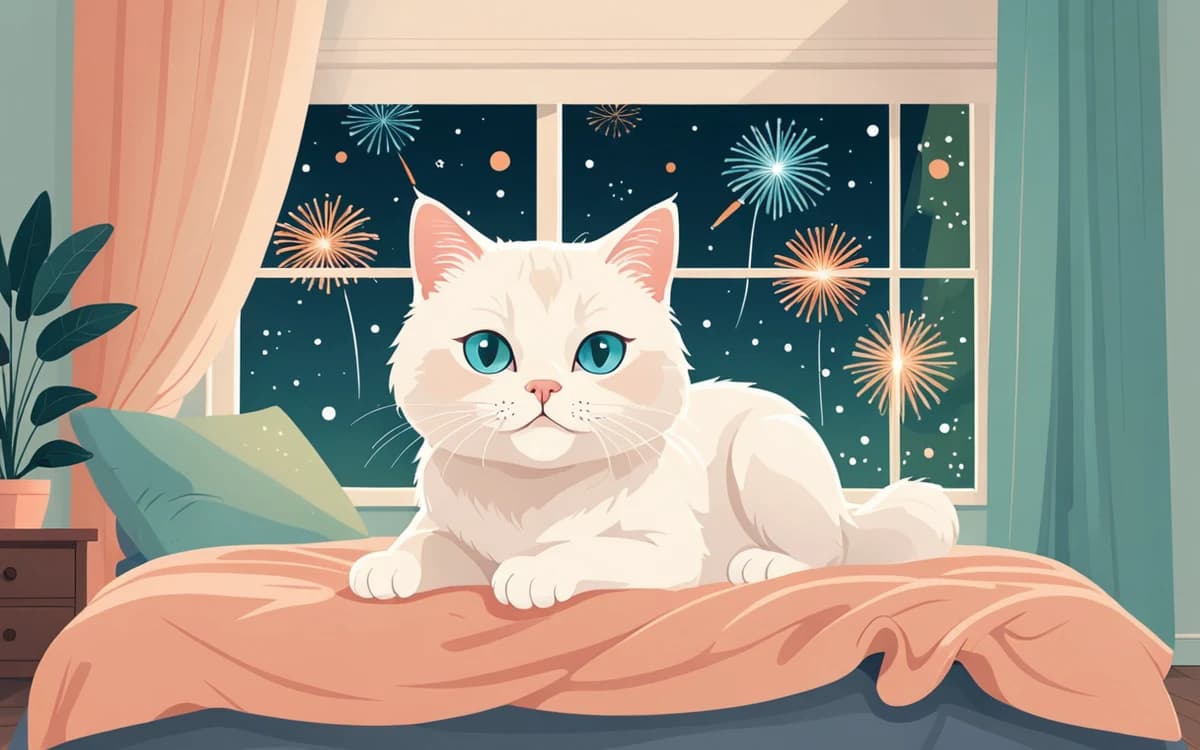
A cat scared of fireworks does best with a plan set up before the noise starts: close windows and curtains, prepare a safe room stocked with food, water, and a litter box, and begin playing calming sound early. Never force contact during the display, and double-check your cat's microchip and doors — firework nights are when cats go missing most.
Quick plan:
- Close windows, curtains, and cat flaps before dusk
- Set up a safe room with food, water, litter, and familiar bedding
- Start calming sound 15–30 minutes before the first fireworks
- Never force your cat out of hiding or scold fearful behavior
- Confirm your cat's microchip details are current and doors stay shut
Why fireworks hit cats so hard
Cats have far more sensitive hearing than we do, picking up higher frequencies and finer changes in pitch and volume. A firework isn't just "loud" to a cat — it's a sudden, unpredictable bang with no warning and no visible source, which is exactly the kind of stimulus a territorial animal is wired to treat as a threat. Unlike an ongoing thunderstorm, fireworks tend to cluster around a handful of predictable dates — New Year's Eve, national holidays, local festivals — which means the stress is intense but short, and worth preparing for specifically rather than treating as background noise. If your cat also struggles when the house fills with visitors around the same dates, our guide to cat stress from holidays and guests covers that overlapping situation.
Start preparing a few days before, if you can
If fireworks are a recurring event on your calendar, a little advance work makes a real difference. In the days leading up to it, play recordings of fireworks or thunder at a very low volume during a calm moment, such as feeding time, and gradually raise the volume across a few short sessions. This kind of light desensitization won't erase the fear, but it can soften the startle response in cats who go through the same event every year. On the day itself, close windows, curtains, and any cat flap earlier than usual — before the light fades and before the first stray bangs begin, since fireworks rarely wait for an official start time.
Set up a safe room before the noise starts
Choose one room, away from windows facing the display, where your cat already feels comfortable. Bring in her litter box, water, food, and a familiar bed or blanket that smells like her. Draw the curtains and, if you have them, add extra soft furnishings — a folded blanket draped over a crate, cushions along a wall — to dampen sound further. Set the room up well before dusk so your cat can settle in on her own terms, rather than being herded in once she's already panicked. Our guide to building a stress-free home for your cat covers how to pick and set up this kind of retreat room by room.
Mask the bangs with sound
Consistent background sound, started before the first fireworks rather than switched on mid-panic, gives your cat's ears something steadier to focus on than sudden bangs.
Calm Cat's calming sound library is built for exactly this kind of evening — start a track in the safe room 15 to 30 minutes before dusk and let it run continuously through the display, rather than turning it on only once the first bang has already startled your cat.
A TV, radio, or fan at a normal volume works too — the goal is a steady sound floor, not silence broken by explosions. See our full guide to calming music for cats for what actually helps versus what's just noise.
What not to do
Don't force interaction. Picking up a frightened cat to comfort her, or pulling her out of a hiding spot to check on her, usually backfires. Let her choose when to come out on her own.
Don't scold or punish. Yowling, scratching at doors, or knocking things over during a display is fear, not misbehavior. Correcting it adds a second stressor on top of the first and rarely stops the behavior.
Don't take her outside "to get used to it." Exposure during an actual display can trigger a bolt reflex — the opposite of desensitization, and a real risk of losing her.
Don't leave doors or windows open "for air." Even a gap of a few centimeters is enough for a frightened cat to squeeze through and disappear into the dark.
Before, during, and after: a simple table
| When | What to do |
|---|---|
| Before (days ahead, if recurring) | Play very quiet recordings of fireworks or thunder during calm moments, raising volume gradually |
| Before (day of) | Close windows, curtains, and cat flaps; set up the safe room; confirm the microchip is up to date |
| Before (day of) | Start calming sound 15–30 minutes ahead of dusk |
| During | Stay calm and nearby without forcing contact; keep every door and window shut |
| During | Let your cat use the safe room freely; never take her outside |
| After | Walk through the house to confirm she's present and settled |
| After | Leave the safe room set up for a day or two in case of lingering jumpiness |
Try calming music with Calm Cat
Free download — iOS & Android, 5 languages.


Why doors and microchips matter more than people think
More cats go missing around fireworks than on almost any other night of the year, because a startled cat's instinct is to run, not to hide in place. Even normally calm, indoor-only cats have been known to bolt through a door left ajar for a delivery or a guest arriving mid-display. Before the evening starts, check that every window, cat flap, and door latch is secure, and confirm your cat's microchip details list your current address and phone number. It's a five-minute check that matters far more on a firework night than on any ordinary evening.
If your cat is still unsettled the next day
A day of extra hiding, reduced appetite, or clinginess after a stressful evening is common and usually resolves on its own within 24 to 48 hours. Keep the routine as normal as possible, leave the safe room accessible, and resist the urge to make a big fuss over her — a low-key, predictable day helps more than extra attention. If your cat's fear returns every time the same dates come round, it's worth building a longer desensitization plan well ahead of the next one. Our guide to calming a stressed cat covers the broader routine — safe retreats, consistency, calming sound — that supports this kind of recovery over time.
Frequently asked questions
Should I give my cat medication for fireworks? Some vets prescribe short-term anti-anxiety medication for cats with a severe, established fear of fireworks, but this isn't a decision to make on your own. If your cat's fear is intense — frantic escape attempts, prolonged hiding, self-injury — talk to your vet well before the next known firework date, since some medications need to be trialed in advance to know they work for your cat.
Will my cat grow out of being scared of fireworks? Not usually on its own, though the intensity can shift year to year depending on general stress levels and prior experiences. Light, repeated desensitization ahead of known dates tends to help more than simply waiting it out.
Is it normal for my cat to hide for hours afterward? Yes — a few hours of extra hiding once the noise stops is common. If it stretches into the next day along with a loss of appetite, it's worth a check-in with your vet rather than assuming it will pass. Our guide on why cats hide covers when hiding crosses from normal into a warning sign.