
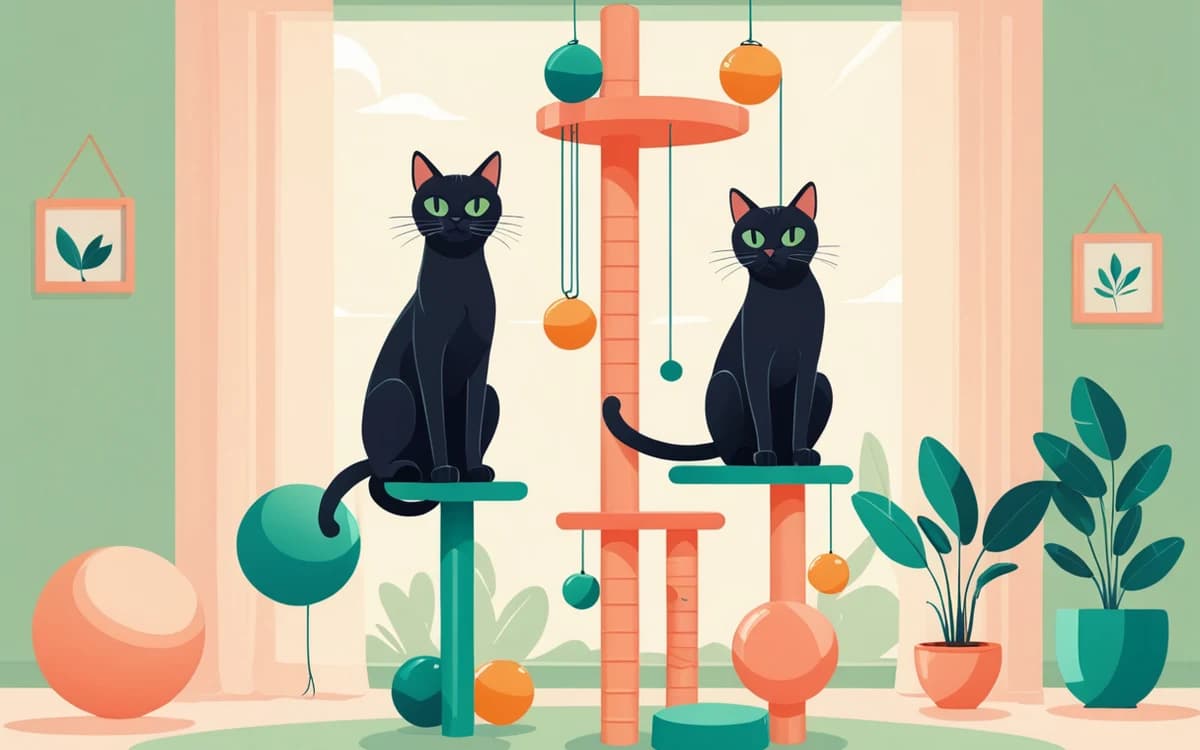
Indoor cats develop stress behaviors — scratching, aggression, apathy, over-grooming — far more often when their environment doesn't let them climb, hunt, forage, or explore. The fix isn't more toys sitting in a basket; it's four specific types of daily stimulation: vertical space, foraging, structured predatory play, and sensory variety. None of it requires a big budget.
Quick checklist:
- Add at least one elevated perch or window ledge your cat can reach freely
- Hide part of her daily food ration instead of serving it all in a bowl
- Run two 10–15 minute wand-toy play sessions a day, not passive toys alone
- Rotate two or three novel objects weekly rather than buying more permanent ones
- Match the enrichment type to the specific behavior you're seeing
Why an under-stimulated cat starts to look "stressed"
A cat confined indoors with nothing to climb, chase, or search for is still wired to do all three. When those instincts have no outlet, the resulting frustration shows up as behavior owners describe as stress: scratching furniture instead of a real target, sudden aggression toward another cat or a person's ankles, apathy and reduced play interest, or over-grooming in cats who have nothing else to do with their energy. Enrichment doesn't just "entertain" a cat — it closes the gap between what she's built to do and what her four walls actually let her do. Our guide to signs of stress in cats covers the broader picture if you're not sure which behaviors point to a stimulation gap versus something else.
The four types of enrichment that matter most
Not all enrichment is equal. Cats need a mix of vertical space, foraging, structured play, and sensory novelty — leaning on just one (usually toys) leaves the other needs unmet.
| Stimulation type | Concrete example | Low-budget option |
|---|---|---|
| Vertical space | Cat tree, wall shelves, access to a window sill | Clear a bookshelf, stack a chair and a box near a window |
| Foraging | Puzzle feeder, treat-dispensing ball | Hide a few kibbles in muffin trays or toilet-paper rolls |
| Structured play | Wand toy, fishing-rod toy, laser + physical toy combo | A shoelace on a stick, a feather from an old pillow |
| Sensory variety | Cat grass, new textures, rotating objects | A cardboard box, a paper bag, a rotated houseplant out of reach |
Vertical space: the cheapest fix with the biggest effect
Cats default to feeling safer above eye level, where they can watch the room without being approached from behind. A cat tree helps, but a cleared shelf, a windowsill with a perch, or even a sturdy chair pushed near a window does the same job. If you have more than one cat, vertical space also reduces tension by giving each cat somewhere to retreat that isn't contested territory.
Foraging: making food "cost" something again
In the wild, a cat works for every meal. A bowl removes that entirely, which is part of why food-motivated indoor cats can become demanding or apathetic. Splitting even half the daily ration into a puzzle feeder, a few hiding spots around the house, or a simple treat-dispensing ball gives her something to do with the hunting instinct that a bowl skips completely.
Structured predatory play: the one most owners skip
Batting a toy mouse around alone isn't the same as a full predatory sequence — stalk, chase, pounce, "kill," then eat or settle. A wand toy or fishing-rod toy lets you recreate that full sequence, which is what actually discharges hunting energy rather than just burning a few calories. Two sessions of 10–15 minutes a day, ideally one before a meal so the sequence ends the way it would in the wild, does more for a restless or destructive cat than an hour of unattended toys ever will.
Sensory variety: rotation beats accumulation
A pile of toys a cat has already investigated stops registering as interesting within days. Cat grass, a new cardboard box, a paper bag, or simply moving furniture around gives her something genuinely novel to explore. The trick is rotation, not accumulation — keep two or three objects "in play" at a time and swap them out weekly instead of letting everything pile up ignored in a corner.
If you're changing your cat's environment, it helps to know whether it's actually working. Calm Cat's per-cat stress tracking lets you log behaviors like destructive scratching, over-grooming, or hiding before and after you add enrichment, so you can see whether a new shelf or a foraging routine is genuinely making a difference — not just guessing.
Matching the behavior to the likely gap
If you're not sure where to start, work backward from what you're actually seeing. This isn't a diagnosis — a vet visit is always worth it if a behavior is new, sudden, or severe — but it's a reasonable starting point.
- Destructive scratching or knocking things over — usually points to a lack of structured play or an outlet for excess energy; add a second daily play session before addressing anything else.
- Aggression toward people or other cats — often territory or vertical-space related, especially in multi-cat homes; see our guide to multi-cat household stress for how resource competition plays into this.
- Apathy or reduced interest in play — check foraging first; a cat getting all her food for free in a bowl can lose motivation to engage with anything.
- Over-grooming — often a stress-coping behavior with no single enrichment fix; sensory variety and predictable play help, but persistent over-grooming is worth mentioning to a vet.
- Restlessness or vocalizing at night — frequently an energy-timing mismatch; see our guide to cat meowing at night for how evening play sessions can shift this.
Try calming music with Calm Cat
Free download — iOS & Android, 5 languages.


A simple daily rhythm that actually sticks
Enrichment fails most often not because the ideas are wrong, but because they're inconsistent. A workable rhythm looks like: a play session in the morning or early evening, food split between a bowl and a puzzle feeder or hiding spots, permanent access to at least one elevated perch, and one rotated novel object at any given time. That's realistic to maintain even on busy days, and it covers all four enrichment types without needing to buy anything new most weeks. Pairing this with a stable daily routine — see our guide on how to calm a stressed cat — tends to compound: predictability plus stimulation covers most of what causes stress in indoor cats.
Common mistakes to avoid
Buying more toys instead of rotating what you have. A basket of forgotten toys does nothing. Two or three objects in active rotation outperform a dozen sitting untouched.
Skipping the "kill" at the end of play. Ending a play session abruptly, mid-chase, can leave a cat wound up rather than satisfied. Let her catch the toy and "win" before you stop.
Only adding enrichment after a problem appears. Enrichment works best as a baseline habit, not a reaction to scratched furniture. Build the four types in before stress behaviors show up if you can.
Ignoring individual preference. Some cats are foraging-driven, others are play-driven. If one category gets no interest after a couple of honest attempts, put your energy into the ones she actually responds to.
Frequently asked questions
How quickly should I see a change after adding enrichment? Some cats respond within days, particularly to structured play; others take two to three weeks, especially for behaviors like over-grooming that have become habitual. Tracking behavior before and after a change makes it much easier to tell if it's working rather than guessing.
Is a cat tree necessary, or can I get away with cheaper options? A cat tree helps but isn't required — a cleared shelf, a windowsill perch, or a chair near a window provides the same vertical access for free or close to it. What matters is that the space is elevated and easy to reach, not the price tag.
My cat still seems stressed despite enrichment — what now? Enrichment addresses one common cause of stress, but not the only one. If stress behaviors continue for more than two weeks despite consistent play, foraging, and vertical space, or if you notice appetite changes, vomiting, or sudden behavior shifts, it's worth booking a vet visit to rule out a medical cause — see our guide on separation anxiety in cats if the stress is specifically tied to being left alone.